A community-powered, queryable “version of the truth” for Intellivision games, hardware, and associated stuff.
We think there is a place for a refreshed “version of the truth” regarding Intellivision games and hardware, so we’re building one!
The Intellivision community has built amazing resources over the decades—now it’s time for a simple, friendly API that makes core catalog facts easy to retrieve, integrate, and reuse across websites, tools, trackers, streams, and research projects.
This Catalog API is designed to provide targeted, structured information (rather than being primarily visual), so it’s perfect for personal tracking, game listings, dashboards, and automation.
✍️ Curated Write: Contributions are reviewed and audited before becoming part of the catalog.
A shared “single source of truth” (without replacing anyone’s favorite site)
When many lists exist, facts drift: this API can give the community a common reference point that apps and people can rely on, while still respecting other comprehensive resources.
A single, stable catalog endpoint reduces confusion, improves collaboration, and makes it easier for builders to “default” to one canonical reference URL.
Machine-readable data unlocks automation and interoperability
If data is structured for computers, it becomes easier to find, access, integrate, and reuse—the core “machine-actionable” benefit that modern data stewardship promotes.
That means anyone can build tools that stay current automatically (instead of manually copying/pasting updates).
Better research: timelines, trends, and discovery
Collectors and historians can query release timelines, regional variants, publishers, and platform eras—then visualize trends without re-entering data.
Example questions your page already hints at—made easier and more consistent via an API: “Find all racing games,” “release-date trends,” “who worked on what,” etc.
An Intellivision Catalog API enables:
- Better preservation of gaming history
Metadata, release details, artwork, manuals, trivia, and catalog relationships become easier to preserve, back up, and mirror for future generations. - New tools for collectors
Collection managers, rarity trackers, wish lists, inventory systems, and market utilities can automatically stay synchronized instead of requiring manual entry. - Smarter front ends and launchers
Emulators, media centers, and game browsers can retrieve rich game information dynamically and present a more complete experience. - Improved discovery of forgotten titles
Hidden gems, prototypes, regional variations, educational software, and lesser-known releases become easier for players to find and explore. - Support for homebrew and modern development
New creators can integrate game information, release data, screenshots, and media into websites, launch systems, and companion applications. - Community-driven research
Historians, authors, preservation groups, and enthusiasts gain a structured source for studying the evolution of the platform. - Reduced duplicate effort
The same information no longer needs to be recreated repeatedly across websites, spreadsheets, forums, and applications. - Interconnected community projects
Tournament systems, score tracking, streaming overlays, online exhibits, FAQ systems, and virtual events can share a common information source. - Education and technical experimentation
APIs provide a foundation for students and developers to experiment with databases, analytics, visualizations, and retro-computing projects. - Future-proofing the community knowledge base
Community knowledge should not live only inside individual websites or personal collections. APIs help ensure information can move, evolve, and survive. - Unexpected ideas nobody has thought of yet
Some of the most useful community projects appear after data becomes available. The API is not just a service; it becomes infrastructure for innovation.
The long-term goal is simple: create a resource that helps the Intellivision community preserve its past while making it easier to build its future.
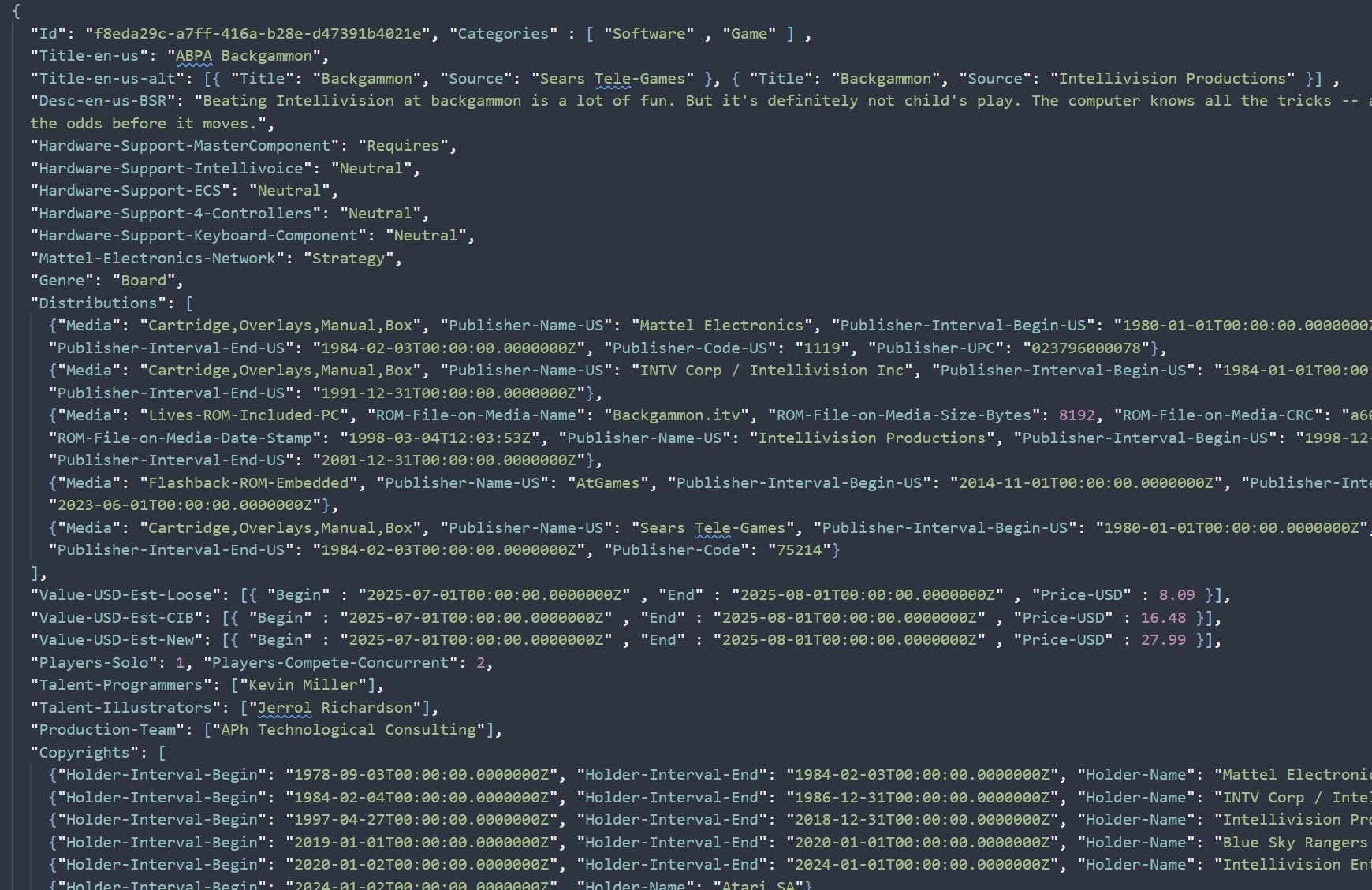
- An Atari Sprint owner that wants to find all of the Racing games?
- A collector looking for release-date trends and timelines?
- A podcaster looking to find Intellivision programming talent to interview?
We hope we can help!
Under Development